
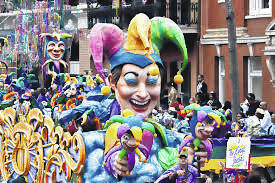

Many of us have heard of the holiday Mardi Gras, know that it takes place in New Orleans annually, and are probably familiar with one or two of the day’s traditions, but few really know why it is celebrated.
How it started
A Christian holiday, though not originally, Mardi Gras is celebrated around the world, mostly in countries with large Roman Catholic populations like France, Germany, Spain, Brazil and England.
Louisiana is the only U.S. state where Mardi Gras is a legal holiday, though celebrations in Alabama and Mississippi also bring large yearly crowds.
Before Christianity left its mark on Rome, Mardi Gras roots sprang from ancient Roman pagan spring and fertility rites.
The first American observance occurred on March 3, 1699, when it was celebrated by French explorers Pierre Le Moyne D’Iberville and Sieur de Bienville. Landing near present-day New Orleans, Louisiana, the Frenchmen held a small party during which they christened where they landed Point du Mardi Gras.
Mardi is the French word meaning “Tuesday” and gras means “fat.”
While Americans may have only been celebrating the holiday since 1699, the day has been celebrated around the globe for thousands of years.
In the decades following the first Mardi Gras celebration in America, New Orleans and other French settlements started marking the day with street parties, masquerade balls and fancy dinners.
Not fans of the frivolous French celebrations, the Spanish outlawed the fun holiday when they assumed occupation of New Orleans. Celebrations remained outlawed until Louisiana became a state in 1812.
When is Mardi Gras celebrated?
Mardi Gras, or Fat Tuesday, is celebrated on the Tuesday before Ash Wednesday. This year, the holiday will be on Tuesday, February 17.
The holiday has always been known for its joyous celebrations and when the Christians attempted to “Christianize” Rome, they decided including Rome’s pagan holidays was easier than trying to erase them altogether. This resulted in the raucous behavior of the Mardi Gras holiday season becoming a natural precursor to Lent, a 40-day fasting period observed by those mainly of the Roman Catholic faith.
Why Fat Tuesday?
Mardi Gras is also known as Fat Tuesday because observers of Lent would outdo themselves overindulging in rich, fatty foods in preparation for the long days ahead of eating fish or observing other forms of fasting.
Mardi Gras over the years
Over time, the name Mardi Gras has become practically synonymous with the word “parade.”
In 1827, students in New Orleans dressed in bright clothes and celebrated in the streets, following Mardi Gras traditions they observed from the French. A decade later, the first known New Orleans Mardi Gras parade would take place.
A secret society of New Orleans businessmen called the Mistick Krewe of Comus organized a torch-lit Mardi Gras parade through the streets of the city in 1857, complete with marching bands and floats.
The most famous krewe will always be the Krewe of Rex.
When the Grand Duke Alexis Romanov Alexandrovitch attended Mardi Gras festivities in 1872, he caused quite a stir locally, resulting in the krewe’s naming a leader for the year named Rex, or Latin for King.
A prominent member of New Orleans is chosen annually to be King of the Carnival, or Rex.
As Rex, the chosen individual is given the symbolic key to the city by the mayor.
In addition to the Mardi Gras parade, krewes have become as beloved a tradition by partygoers as those of throwing beads, wearing masks, and eating King Cake.
Reinvented almost as many times as Madonna, these days King Cake is most often a braided Danish pastry sprinkled with cinnamon and decorated in icing colors representative of the holiday; purple, green and gold.
Originally, the dessert started out as a basic ring of dough.
Uniquely, the cake contains a small replica of the baby Jesus. It’s said whoever finds the infant Lord is supposed to hold the next party or get together.
Previously, the baby Jesus was plastic, then he became porcelain and even gold. Nowadays, many bakers are fearful of legal ramifications and include the baby on the side in separate packaging.
When it comes to bead throwing, it is far and wide the most popular tradition of the week-long Mardi Gras season.
The initial concept was for each Mardi Gras themed color of bead to be thrown to a person in the crowd with traits symbolic of the color each is said to represent, purple for justice, green for faith, and gold for power.
Another quaint holiday tradition that in this case used to involve throwing are Zulu coconuts.
Given out by the Zulu Social Aid and Pleasure Club, the coconuts used to be left au natural when they were tossed into throngs of revelers. Over time, and fearing lawsuits, the coconuts stopped being hurled at innocent people and started being decorated in the bright colors and glitter of the holiday.