
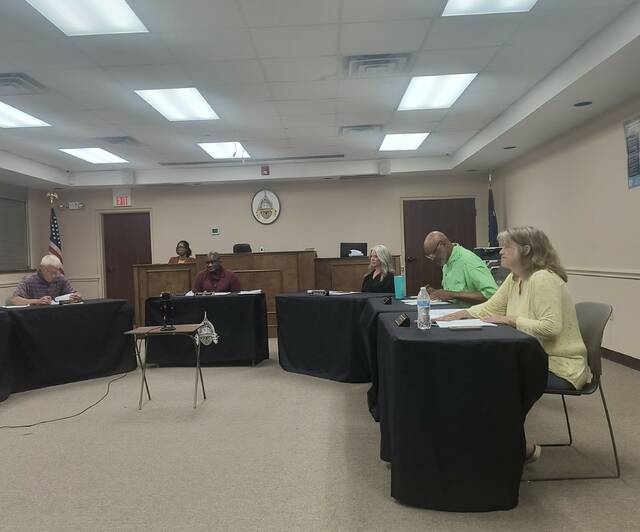
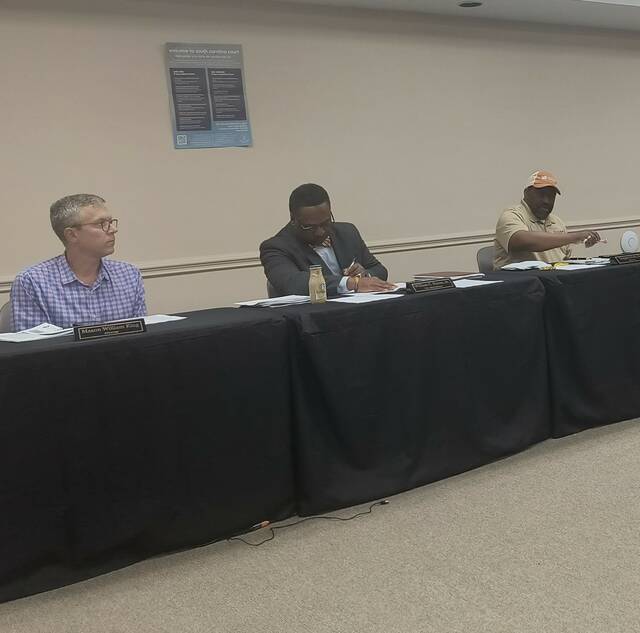

BENNETTSVILLE — The Bennettsville City Council has focused relentlessly on the city’s 2026–2027 fiscal budget of late, putting in long hours of discussion and compromise even ahead of the budgets first reading on April 16, during which council voted to approve the first reading of the budget.
Following the council’s tepid agreement with the first reading of the budget, at least three more budget workshops discussing the budget have taken place: April 28, May 1, and May 5. All three workshops were filled with lengthy, often contentious debates, revealing cracks in the council’s cohesion regarding individual member stances on issues related to the city’s fiscal priorities, staffing decisions, and administrative practices.
April 28
Chief among concerns expressed by council members are procedural concerns, with several members noting the complete budget document was not made readily available to the public prior to the meeting.
Councilman Cy’Heim McRae said, “I am unable to support this budget as it is, as it stands right now — and like I said, I asked… I even asked the other day while I was out of town for it [proposed budget] to be published and it still hasn’t been published. Not to my knowledge now.”
Some members argued that this limited transparency reduced opportunities for community review and input. Discussion also centered around some council members’ objections regarding the structure of certain budget lines, including how much fleet leases cost and how property purchases are categorized.
“I am having a problem with the fleet lease agreements almost doubling,” Councilwoman Wanda Weaver said. “There’s another fleet lease listed in here — that even takes our fleet lease over $400,000 close to $500,000, I’m not happy with that. So, right now, my vote will be a no,” she added.
City Administrator William Simon Jr. explained, “It’s combined here to better manage it. It was embedded in different departments. And when vehicles would come and go, or if there was an accident, or if a position was taken from one area to another, or if we had to loan a truck to a different department long term, it was just really convoluted and couldn’t keep up with it.”
He said the change is intended to improve oversight of city vehicles, particularly those shared across departments or reassigned after accidents or long-term loans.
Key in budget debates is still the long-vacant Assistant City Administrator and Director of Public Utilities [DPU] position, the latter having remained unfilled for roughly three years.
Mayor Tyron Abraham expressed frustration at the role of DPU remaining unfilled.
“I understand that the DPU position is a very important position and that position has been open now for some time. And the reason why I was asking to freeze that position was that as council and administrator we could go back and regroup, look at maybe looking at a better incentive package that we could offer,” the mayor suggested.
Council shared differing views on the future of the DPU role, with some members accentuating its operational significance, and others supporting a temporary freeze on the job to allow time for council to reconsider salary levels, recruitment approaches, and required qualifications, like should a candidate be required to live within city limits.
Providing additional context, Simon explained that apart from the administrator position, city employees are not required to live within city limits. He said that approximately one-third of the city’s 128 employees currently reside outside the city, and about 20% live outside the county.
Council also revisited reasons why the utilities leadership position has remained vacant, citing recruitment difficulties, restrictive criteria imposed in the past, administrative requirements exceeding normal policy, and concerns from at least one former candidate about extensive one-on-one meeting requests with council members.
When questioned further about the city’s finances, Simon clarified the proposed budget was balanced and did not include a true deficit. He explained earlier references to a projected $400,000 shortfall stemmed from a more conservative planning method used during budget workshops, not from the final figures presented for approval.
Simon also outlined several planned projects supported by federal ARPA funding and the proposed budget. These included upgrades to tennis courts and the community center, improvements to fire department housing and facilities, renovations to neglected neighborhood parks, downtown revitalization efforts such as business grants and a fully funded awning program, and the purchase of essential equipment for public works and utilities to reduce reliance on expensive rentals.
Despite extended discussion and clarification, the council failed to pass the budget on second reading. The motion did not receive enough support, leaving the city without an officially adopted budget for the upcoming fiscal year.
May 1
To address unresolved issues, members scheduled a budget workshop for April 30, with debate carrying over to a special City Council meeting on May 1, convening the meeting in an attempt to resolve council’s ongoing budget impasse. Progress was hampered by the absence of the city attorney and two council members [Councilman Cy’Heim McRae and Councilwoman Caraline Harpe], creating uncertainty among present members regarding the legality of proceeding.
Ultimately, much of the discussion centered around whether the city can temporarily rely on the prior year’s budget or whether it is required to continue following the process established during the first reading of the current proposal.
Simon clarified for council that under local ordinance, the originally proposed budget remains in effect until a final version is formally adopted and he emphasized council is still legally required to continue working toward final approval.
The stalemate continued, with council members also considering a 90-day hiring freeze for certain vacant positions, including roles tied to police administration, customer service, and utility operations. Concerns were raised about the operational impact of such delays, particularly on the police department’s ability to maintain adequate staffing levels. Further complicating matters were the absence of finalized financial data for April, which members say make it difficult to determine available carryover funds for the new fiscal year.
After prolonged debate and several revised motions, the council ultimately agreed to move forward with the budget version that passed its first reading, stressing the decision is temporary. Council expressed visible frustration, acknowledging absences, scheduling issues, and procedural uncertainty has slowed critical decisions that are now affecting city operations.
Members concluded the meeting deciding to reconvene Tuesday, May 5, with legal counsel present, to revisit potential changes once updated financial information and clearer guidance are available.
May 5
True to their words, council kicked off Tuesday night’s budget workshop with a vote to go into executive session. Approved, council spoke with the city attorney for about an hour, before returning to public discussion.
Councilman Cy’Heim McRae asked City Administrator Simon what changed in the budget.
Simon explained, “We were able to go back in and look at some of the revenues and we made some adjustments on the revenue side.” He continued, “It is everything you asked for, the budget is balanced, we adjusted some revenues—and we did it in a safe way.”
Requesting specifics, Councilwoman Harpe asked for a detailed breakdown of the revenue adjustments, and Simon answered that the city is projected to be up $10,000 in motor carries taxes, $50,000 in real estate taxes, $10,000 from working with the county to make operational changes regarding delinquent tax collection, $4,100 in building permits, and $10,000 in vehicle tax collection.
McRae said he felt the hospitality tax transfer needs to be separated from the general fund, suggesting a need to see what money is coming in, where it is going, and how it can best be spent to attract future tourism to the area, aiding small local business.
Mayor Pro Tem William Jennings Jr. said he felt the city was moving in the right direction when it came to pursuing the collection of delinquent taxes, though he added he thinks council should continue to focus on strengthening its tax collection abilities.
Councilman Tyrone Davis Sr. raised the need for council to inform residents of fee or tax increases well in advance of the announced action being implemented.
“Anytime that we are increasing taxes, however we do it, by election or whatever, we need to start informing our citizens long before we do it,” Davis said.
Tuesday night’s budget workshop concluded with council deciding to add the proposed budget, as is, onto the agenda of the city’s next council meeting.
Leave a Reply
You must be logged in to post a comment.