
What would happen if the masses were to suddenly glimpse a clown floating down the river in a bathtub pulled by geese, you may ask and I’m glad you did because the story of Arthur “Nelson” the Clown answers just that.
Initially amusing, Nelson the Clown’s stunt inadvertently resulted in the deaths of 79 spectators.
On the evening of May 2, 1845, hundreds of people gathered in Great Yarmouth, Norfolk, to watch one of the oddest public spectacles ever seen: a circus clown floating down the River Bure in a bathtub that appeared to be pulled by four geese, or possibly swans. Sure, it was the Victorian era, but such a sight might still be impressive to even today’s unfazed generation.
A popular entertainer with William Cooke’s Royal Circus, Nelson the Clown, was known for his unusual aquatic stunts drawing crowds. Surviving handbills from the day differ, with some listing the fowl pulling Nelson’s floating washtub as four geese, and others describing swans. The idea was for the event to advertise the circus while in town.
The stunt began at Haven Bridge and floated toward the Yarmouth Suspension bridge at North Quay. As the procession continued, the number of spectators only increased. Reportedly, several thousand people lined the riverbanks to witness the event. Feeling the energy, Nelson was busy waving exuberantly at his admirers when tragedy struck!
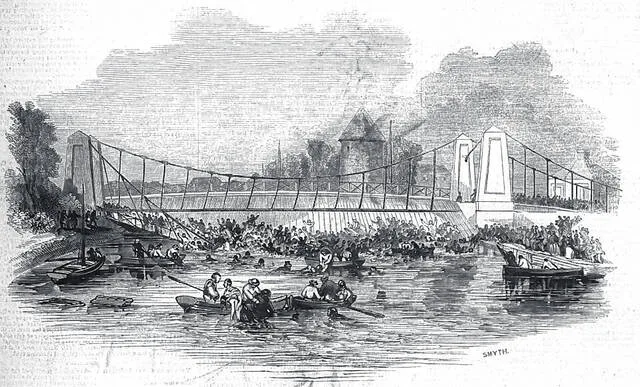
Attendees stretched from the riverbanks to the nearby Yarmouth Suspension bridge. Around 5 p.m., a section of the crowd on the bridge pushed toward one side when Nelson’s bathtub drifted into view. This sudden shift, occurring around 5:40 p.m., placed enormous strain on the structure, causing suspension rods and chains to snap. The bridge swung to the side at a sickening angle, leaving nearly 400 spectators hanging until the deck violently crashed beneath their feet, tossing them like dolls into the River Bure.
Going from comedy to death real quick, victims became trapped in the nearly 7 feet of water when sections of the bridge penned them, or they became trapped by other victims and rescue workers. One harrowing tale of survival involved a young child resisting being swept away by the skin of her teeth —literally clamping on to the hem of her mother’s dress.
All told, Nelson’s frivolous stunt designed to entertain, claimed the lives of 79 people. The incident marks the deadliest bridge collapse in British history. According to records, 51 of the victims were under the age of 14.
Following the incident, it came to light that when the Yarmouth Suspension bridge was widened in 1832, architects failed to align the new construction with the existing infrastructure of the bridge, built in 1829. Investigators uncovered other construction and design flaws they identified as being potential contributing factors to the collapse.
The deadliest event in Yarmouth history, residents were naturally paralyzed with grief and in 2013, designed a memorial at the site of the disaster. Showing no ill will towards the accidental “killer” clown, the people of Yarmouth erected a memorial featuring images of Nelson with his geese and the names and ages of all victims.