

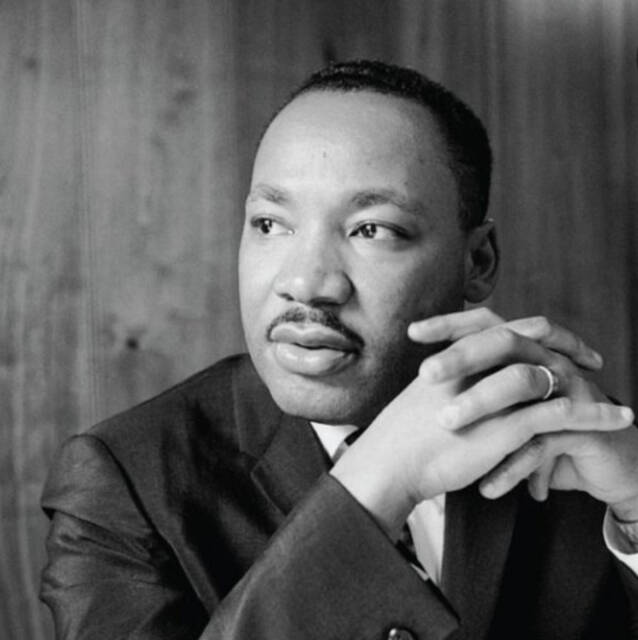
Contributed
Dr. Martin Luther King Jr. grew up in a large, Victorian style house located at 501 Auburn Avenue in Atlanta, a well-to-do street with a large African American population. Born January 15, 1929, King was born inside the family home to Michael King Sr. and Alberta Williams King, who were by all accounts loving and supportive parents who placed emphasis on their children’s education.
King Jr. had an older sister named Christine King Farris and a younger brother named Alfred Daniel Williams King.
Martin Luther King Jr. was actually born with the name of Michael after his father, who had both of their names legally changed to Martin when MLK was very young.
His father, a pastor at Ebenezer Baptist Church, poured into MLK a strong moral character and an interest in social justice. King would later take over his father’s role in pastoring the flock at Ebenezer following his father’s death from a heart attack in 1931.
King would spend his formative years attending various public schools around Atlanta.
While attending high school at Booker T. Washington High School, King was quarterback of the football team. A promising and impressive student, King graduated from the public education system at the age of 15. In 1945, he attended Morehouse College.
Education was so valued in the King home because King Sr. had been forced to work odd jobs in order to make ends meet while studying and cultivating a reputation for himself as a spiritual leader in the Atlanta community.
MLK’s father was the second of ten children and decided to leave home at the age of 16 armed with only a sixth-grade education. King Sr. learned from watching his father, James Albert King, a sharecropper, the value of hard work and education.
A graduate from Spelman University, King’s mother also attended Hampton Institute in Virginia. When she met King Sr., Alberta Williams was working as a teacher in Atlanta. Meeting Williams turned out to be fortuitous for the elder King as her father, Reverend Adam Daniel Williams, was the pastor at Ebenezer Baptist Church at that time.
Despite growing up in a largely African American community, King still experienced instances of racism throughout his childhood. One moment that would forever haunt the young King was when a white childhood friend was forbidden to play with him. His parents used the incident to discuss with their children their own experiences with handling racism. Thus, King learned to be comfortable with speaking out against the racial injustice he saw.
Another incident occurred later when King was in high school and competing in an oratory contest taking place in Valdosta, Georgia. Ultimately taking home the second-place prize, King’s victory was tainted by his long trip back home to Atlanta. Segregated by discriminatory societal norms, black people were forced to stand so white passengers could sit.
His parents played a larger-than-life role in young King’s life.
King credited his father with having the strongest influence on his life-long desire to stand up for instances of social injustice he witnessed and encouraged him to speak out against racism and discrimination. King said his mother strived to instill a sense of self-worth in him through teaching him that he was just as good as anyone else, further cementing in him the courage to be the Civil Rights leader needed by the nation.